Ask your model.
Supply a question and text context, or ask supported questions using fresh records from your connected source.

Predictions trained on your data.
Train a model to estimate outcomes, classify information, and score new cases. Use its predictions to make more informed decisions. You choose what happens next.
For individuals, startup founders, and teams.
Explore a sample prediction
Your past examples
Notes + your category labels

A new research note
Participants were randomly assigned to two groups. Each group followed a different study procedure.
Ready to process this example.
Suggested category
Using your defined categoriesYour past examples
Historical opportunity records
A new opportunity
Budget approved. Two stakeholders attended the demo. Contract review is scheduled.
Ready to process this example.
Estimated chance of closing
Within the next 7 daysYour past examples
Incident reports + severity labels
A new incident
Requests are failing in one region. Retries succeed in another. The incident began 8 minutes ago.
Ready to process this example.
Highest-probability category
SEV-0 · SEV-1 · SEV-2 · SEV-3Illustrative tasks and sample outputs, not predictions from a live model. Training currently starts with a supported integration; contact us about other datasets.
01 / Build
Describe the outcome you care about. Tuned Predictions helps prepare examples from your connected data, then brings training and model versions into one place.
Choose a source and explain what the model should learn. Review the prepared data and the answers it will train on.
“Use my past opportunities to learn which deals close within seven days.”
See the full workflowYour training goal
Which deals will close in the next seven days?
Review the inputs and outcomes before training.
Connected tools.
Useful training data.
 Customer records
 Support conversations
 FirefliesMeeting notes
02 / Evaluate
Test on examples kept out of training. Compare the results with a baseline and inspect the mistakes before choosing how to use your model.
| Research note | Expected | Baseline | Your model |
|---|---|---|---|
| How the study was run | Methods | Findings | Methods |
| What the study found | Findings | Findings | Findings |
| Limits of the evidence | Limitations | Limitations | Methods |
Review overall performance and results for each question. Keep the dataset and evaluation attached to each experiment.
Compare versions on the same test data. A completed training run is a starting point, not proof of a better model.
Explore the product03 / Use
Use it for yourself, in a project, or with your team. Hosting a model does not mean publishing it for others.
Supply a question and text context, or ask supported questions using fresh records from your connected source.
Call your deployed model through the API. Get a probability, category, or score you can use in your own product.
Generate predictions across records, filter the results, and save a workflow you can run again.
Predictions inform. You decide. Outputs are estimates, not guaranteed outcomes. Review the evidence and use your judgment before acting.
Your model can be for your own use from start to finish. You don’t need to publish it or sell access.
Schedule data refreshes and retraining as new outcomes arrive. Keep each experiment’s data and results, then decide which version to use.
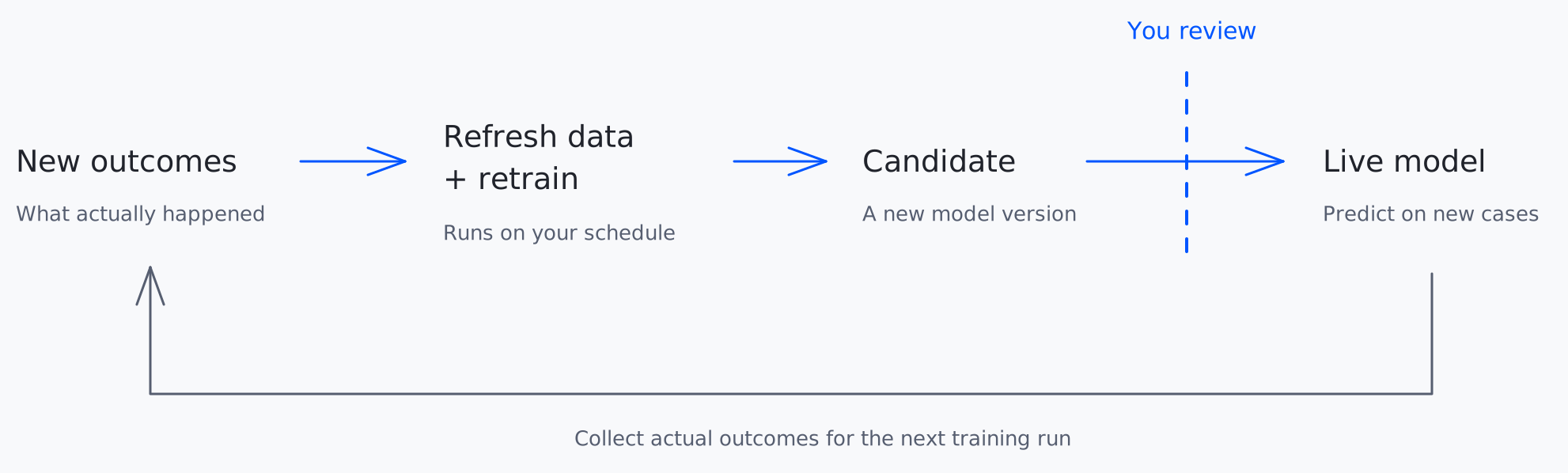
Future outcomes feed the next training run.
Every prediction has a trace. Follow it back to the model version, source data, and inputs behind the result.
Build your modelNo. Tuned Predictions is for individuals, founders, developers, and teams with a specific question and examples to learn from. Use a model for your own tasks or build it into a product. Publishing or selling access is optional, and is planned for a future release.
You can start by describing your goal. You’ll still review the prepared data and choose how to use the results. Initial training and deployment currently need setup support.
The current training workflow starts with Attio, Pylon, or Fireflies. Use examples with known outcomes or labels, and only information available at prediction time. For other sources or personal datasets, contact us about the setup.
No. Predictions are estimates based on the data and model used. They can be wrong. Use them alongside your judgment and other information; you remain responsible for the actions you take.
Run an evaluation on held-out examples. Inspect accuracy, mistakes, and available baseline comparisons. Training doesn’t guarantee an improvement; the results help you decide whether a version is useful.
Yes. Publishing is not part of the required workflow. Use your deployed model in the app or through the API for your own projects. Running an exported model on your own machine is a separate path that isn’t a self-service feature today.
No. Scheduled refreshes can prepare fresh data and train another version using saved settings. Evaluation and deployment are separate steps. A new training run does not automatically replace your deployed model.
Resources
Follow data preparation, training, evaluation, and deployment in one workflow.
Explore IntegrationsExplore Attio, Pylon, and Fireflies as sources for your training examples.
Explore Trust CenterUnderstand model evaluation, traceability, and questions for your security review.
ExploreFrom the blog
Practical guides to the data, models, and choices behind the result.
Use held-out examples, inspect the mistakes that matter, and compare available baselines before deciding whether a trained prediction model is ready to use.
Read article Data preparation · 2 min readTurn a broad goal into a prediction task with a clear outcome, usable examples, and inputs that reflect what you will actually know at prediction time.
Read article Model lifecycle · 2 min readUnderstand why fresh outcomes can justify another training run, what to compare between model versions, and why deployment remains a separate review step.
Read article